|
Seawater is a complex
solution containing a wide variety of organic and inorganic
chemicals. While some of these are frequently discussed by
reef aquarists, others are rarely mentioned. Without a working
knowledge of what is present in natural seawater, it is often
difficult to assess aquarium problems, as well as the claims
of manufacturers and other aquarists about what additives
and methodologies are desirable in maintaining reef aquaria.
This article is intended to help aquarists better understand
the water in their aquaria. It strives to give a better understanding
of what happens in seawater than does a simple table of elemental
concentrations, although such tables are also provided.
The topics covered are:
In the references section are links to articles about many
of the individual ions present in seawater that most interest
reef aquarists. This article does not try to describe what
commercial artificial seawater and reef aquarium water contain.
The following linked articles are more useful for those purposes:
A
Chemical Analysis of Select Trace Elements in Synthetic Sea
Salts and Natural Seawater
It's
(In) the Water
What
We Put in the Water
It
Is Still in the Water
The
Composition Of Several Synthetic Seawater Mixes
The Water Itself
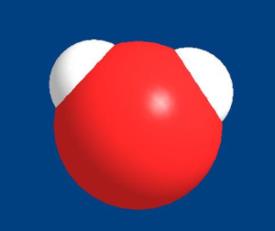
A water molecule is composed of two
hydrogen atoms bonded to a single oxygen atom (H2O;
Figure 1). Water comprises about 96.5% of the mass of natural
seawater. A 100 gallon aquarium contains approximately 12,500,000,000,000,000,000,000,000,000
water molecules. One of water's most important properties
is that it is primarily a liquid, rather than a gas, at room
temperature. Most other molecules of similar size and weight
(e.g., oxygen, O2; nitrogen, N2;
ammonia, NH3) are gases at room temperature.
The reason that water is a liquid is that it forms strong
intermolecular hydrogen bonds in which the hydrogen atom from
one water molecule forms a transient chemical bond, called
a hydrogen bond, to the oxygen atom in a nearby water molecule.
While each of these bonds lasts only a fraction of a second,
it rapidly and repeatedly reforms after being broken. This
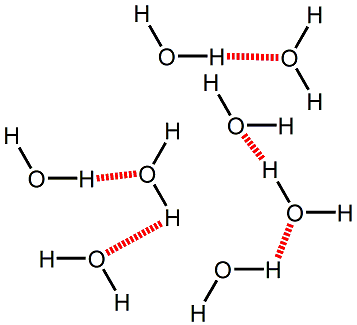
network of hydrogen bonds (Figure 2) holds
the water together as a liquid rather than letting it fly
apart as a gas.
Water forms hydrogen bonds because the electrons in water
molecules are not evenly distributed. Oxygen is more electronegative
than hydrogen, so the central oxygen atom draws electrons
from the hydrogen atoms toward itself. This movement of electrons
leaves the oxygen atom with a partially negative charge and
the hydrogen atoms with a partially positive charge; this
redistribution of electrons is called a dipole. When one water
molecule interacts with another, there can be an interaction
between a partially positively charged hydrogen atom and a
partially negatively charged oxygen atom, creating a "hydrogen
bond."
|
|
Figure 1. A space-filling model of a water molecule.
The central oxygen atom is shown in red, and the two
hydrogen atoms are shown in white.
|
Additionally, water's dipolar nature allows it to interact
strongly with charged ions in solution. Several water molecules,
for example, cluster around each ion, and orient themselves
to take advantage of these ion and partial
ion interactions. For example, water orients with its oxygen
atoms pointed toward the positively charged calcium ion (Ca++)
in solution. This effect is very important for many properties,
from solubility to osmotic pressure.
Figure 2. A schematic diagram of water molecules connected
by hydrogen bonds (shown in red).
Seawater's Physical Properties
Seawater tends to
have a higher density than does freshwater, due to seawater's
higher density of dissolved salts. Seawater with a salinity
of 35 ppt is about 1.0264 times as dense as freshwater at
the same temperature, and so is said to have a specific gravity
of 1.0264. This property is the reason that hydrometers
are a suitable way to measure salinity.
Seawater also refracts light (bends light passing through
it) more than freshwater does. This effect is due to the more
refractive nature of the ions in solution compared to freshwater.
The refractive
index of freshwater is about 1.33300 while that of seawater
with a salinity of 35 ppt is about 1.33940. Refractometers
take advantage of this property and allow aquarists to measure
salinity by refractive index.
The charged ions in seawater can conduct electricity. Not
only does this attribute make seawater aquaria dangerous from
an electrical safety perspective, it also allows aquarists
to measure salinity
via conductivity. The more charged ions present, the higher
the conductivity, and a device that can appropriately measure
conductivity can lead to useful determinations of the salinity.
The conductivity of seawater with a salinity of 35 ppt is
53 mS/cm, while for purified freshwater, it is below 0.001
mS/cm.
When seawater evaporates, water enters the atmosphere, but
salts generally remain behind. These salts can then become
more and more concentrated if the evaporated water is not
replaced, or if it is replaced with seawater containing additional
salts. When this happens in a salt collection pond, it may
be desirable, but if it happens in a closed lagoon or a marine
aquarium, the salinity may rise to the point at which marine
organisms are stressed or killed.
Seawater, with its many charged ions, has a higher osmotic
pressure than does freshwater. In short, water "prefers"
to be mixed with the charged ions. That is, it is in a lower
energy state when it contains charged ions for the reasons
described in the previous section. Consequently, if freshwater
and salt water are separated by a membrane that only water
can pass through, water will stream from the freshwater into
the salt water. If that process is allowed to equilibrate,
water will flow until the salt concentrations on each side
are the same or, if pressure is allowed to build, it will
continue until higher water pressure on the seawater side
pushes back against the incoming water to stop it. That pressure
is called osmotic pressure. The osmotic pressure between 35
ppt seawater and freshwater is 25.9 bar (25.5 atmospheres)
at 25°C.
Because water is attracted to salts in seawater, water vapor's
pressure over seawater is lower than over freshwater at the
same temperature. It is about 2% lower over seawater, which
at 25°C is 23.323 mm Hg, while freshwater has a vapor
pressure of 23.756 mm Hg at the same temperature.
Ions and other dissolved chemicals are usually quick to diffuse
and otherwise mix through a few feet of water. An aquarium
with typical circulation will show no significant differences
in chemical properties as a function of depth or across the
aquarium, except in the case of things being continually added
(such as dripping limewater) that may take time to be fully
mixed in. The ocean, where distances are much greater compared
to the movement of currents and diffusion in a few days time
frame, can show significant variations in chemical composition
as a function of depth and location.
Seawater with a salinity of 35 ppt has a freezing point that
is 1.9°C (3.4°F) lower than freshwater. This freezing
point depression comes about because the ions in the water
tend to make the water more stable in its liquid form than
as a solid. When seawater freezes, most ions are excluded
from the ice, although some, such as sulfate, can be incorporated
to some extent. Consequently, the salts in sea ice do not
match the seawater's composition.
pH
The pH
of seawater is typically stated to be 8.2 ± 0.1, but
it can vary as photosynthesis consumes carbon dioxide locally
and as respiration produces it. It also varies by latitude
and is often lower where there is upwelling. It is also a
function of depth for a variety of reasons, including photosynthesis
near the surface, decomposition of organics in the mid-depths
(dropping pH to as low as 7.5 by 1000 meters), and dissolution
of calcium carbonate in very deep water (raising the pH back
up to around 8). In closed lagoons, the pH can cycle from
day to night just as in a reef aquarium, rising several tenths
of a pH unit during the day. In special circumstances, seawater
can be much lower in pH. Seawater in mangroves where highly
reducing sediments are present can reduce the pH to below
7.0. In the open ocean, where there is a much larger volume
of water containing buffers, the pH fluctuates little. As
humans have added carbon dioxide to the atmosphere, more carbon
dioxide has also been added to the oceans, with a consequent
drop in pH. This is one of the impacts humans have had on
the oceans that concerns ecologists in terms of its impact
on calcifying organisms, especially on coral reefs but also
on other systems involving such organisms as foraminiferans,
which have calcareous skeletons and which are important links
in many marine food webs.
The alkalinity
of natural seawater is primarily a measure of bicarbonate
plus two times the carbonate concentration. In the ocean,
it varies by location and depth. In surface waters, it usually
varies between about 2.25 and 2.45 meq/L (6.3 to 6.9 dKH),
and often varies with changes in salinity. In deep water and
upwelling water, it may be higher due to dissolution
of calcium carbonate that is driven by pressure.
Elements in Seawater
Nearly every element known to man
has been found in seawater (Table 1). Some are present at
very high concentrations, and some are vanishingly rare. This
linked website shows a periodic
table of elements that can be pointed
at with the cursor to see the concentration of each in seawater,
as well as a host of other properties of the element. The
sections that follow in this article detail the concentrations
and other interesting aspects of many of the elements of most
interest to reef aquarists.
|
Table
1. Concentrations of many elements in natural seawater.
|
| Element |
Symbol
|
Atomic
Number
|
Seawater
Concentration Range
|
Approximate
weight concentration*
|
| Lithium |
Li
|
3
|
25
µM
|
174
µg/L
|
| Beryllium |
Be
|
4
|
4-30
pM
|
270
pg/L
|
| Boron |
B
|
5
|
0.42
mM
|
4.5
mg/L
|
| Carbon |
C
|
6
|
2-2.5
mM
|
30
mg/L
|
| Nitrogen |
N
|
7
|
0-45
µM
|
630
µg/l
|
| Fluorine |
F
|
9
|
68
µM
|
1.3
mg/L
|
| Sodium |
Na
|
11
|
468
mM
|
10.8
g/L
|
| Magnesium |
Mg
|
12
|
53.2
mM
|
1.29
g/L
|
| Aluminum |
Al
|
13
|
5-40
nM
|
1.1
µg/L
|
| Silicon |
Si
|
14
|
0-180
µM
|
5
mg/L
|
| Phosphorous |
P
|
15
|
0-3.2
µM
|
99
µg/L
|
| Sulfur |
S
|
16
|
28.2
mM
|
900
mg/L
|
| Chlorine |
Cl
|
17
|
546
mM
|
19.4
g/L
|
| Potassium |
K
|
19
|
10.2
mM
|
398
mg/L
|
| Calcium |
Ca
|
20
|
10.3
mM
|
412
mg/L
|
| Scandium |
Sc
|
21
|
8-20
pM
|
900
pg/L
|
| Titanium |
Ti
|
22
|
few
pM
|
150
pg/L
|
| Vanadium |
V
|
23
|
20-35
nM
|
1.8
µg/L
|
| Chromium |
Cr
|
24
|
2-5
nM
|
260
ng/L
|
| Manganese |
Mn
|
25
|
0.2-3
nM
|
165
ng/L
|
| Iron |
Fe
|
26
|
0.1-2.5
nM
|
140
ng/L
|
| Cobalt |
Co
|
27
|
0.01
- 0.1 nM
|
6
ng/L
|
| Nickel |
Ni
|
28
|
2-12
nM
|
700
ng/L
|
| Copper |
Cu
|
29
|
0.5-6
nM
|
380
ng/L
|
| Zinc |
Zn
|
30
|
0.05-9
nM
|
590
ng/L
|
| Gallium |
Ga
|
31
|
5-30
pM
|
2
ng/L
|
| Arsenic
|
As
|
33
|
15-25
nM
|
1.8
µg/L
|
| Selenium |
Se
|
34
|
0.5-2.3
nM
|
180
ng/L
|
| Bromine |
Br
|
35
|
0.84
mM
|
67
mg/L
|
| Rubidium |
Rb
|
37
|
1.4
µM
|
120
µg/L
|
| Strontium |
Sr
|
38
|
90
µM
|
7.9
mg/L
|
| Yttrium |
Y
|
39
|
0.15
nM
|
1.3
µg/L
|
| Zirconium |
Zr
|
40
|
0.3
nM
|
27
ng/L
|
| Niobium |
Nb
|
41
|
50
pm
|
4.7
ng/L
|
| Molybdenum |
Mo
|
42
|
0.11
µM
|
10.5
µg/L
|
| Technetium |
Tc
|
43
|
none
stable
|
none
stable
|
| Ruthenium |
Ru
|
44
|
‹0.05
pM
|
‹5
pg/L
|
| Palladium |
Pd
|
46
|
0.2
pM
|
21
pg/L
|
| Silver |
Ag
|
47
|
0.5-35
pm
|
3.8
ng/L
|
| Cadmium |
Cd
|
48
|
0.001-1.1
nM
|
124
ng/L
|
| Indium |
In
|
49
|
1
pM
|
115
pg/L
|
| Tin |
Sn
|
50
|
1-12
pM
|
1.4
ng/L
|
| Antimony |
Sb
|
51
|
1.2
nM
|
146
ng/L
|
| Iodine |
I
|
53
|
0.2-0.5
uM
|
64
µg/L
|
| Cesium |
Cs
|
55
|
2.2
nM
|
290
ng/L
|
| Barium |
Ba
|
56
|
32-150
nM
|
21
µg/L
|
| Lanthanum |
La
|
57
|
13-37
pM
|
5.1
ng/L
|
| Cerium |
Ce
|
58
|
16-26
pM
|
3.6
ng/L
|
| Praseodymium |
Pr
|
59
|
4
pM
|
560
pg/L
|
| Neodymium |
Nd
|
60
|
12-25
pM
|
3.6
ng/L
|
| Samarium |
Sm
|
62
|
3-5
pM
|
750
pg/L
|
| Europium |
Eu
|
63
|
0.6
- 1 pM
|
150
pg/L
|
| Gadolinium |
Gd
|
64
|
3-7
pM
|
1.1
ng/L
|
| Terbium |
Tb
|
65
|
0.9
pM
|
143
pg/L
|
| Dysprosium |
Dy
|
66
|
5-6
pM
|
975
pg/L
|
| Holmium |
Ho
|
67
|
1.9
pM
|
310
pg/L
|
| Erbium |
Er
|
68
|
4-5
pM
|
835
pg/L
|
| Thulium |
Tm
|
69
|
0.8pM
|
135
pg/L
|
| Ytterbium |
Yb
|
70
|
3-5pM
|
865
pg/L
|
| Lutetium |
Lu
|
71
|
0.9
pM
|
157
pg/L
|
| Tungsten |
W
|
74
|
0.5
nM
|
92
ng/L
|
| Rhenium |
Re
|
75
|
14-30
pM
|
5.6
pg/L
|
| Iridium |
Ir
|
77
|
0.01
pM
|
1.9
pg/L
|
| Platinum |
Pt
|
78
|
0.5pM
|
98
pg/L
|
| Gold |
Au
|
79
|
0.1-0.2
pM
|
39
pg/L
|
| Mercury |
Hg
|
80
|
2-10
pM
|
2
ng/L
|
| Thallium |
Tl
|
81
|
60
pM
|
12
ng/L
|
| Lead |
Pb
|
82
|
5-175
pM
|
36
ng/L
|
| Bismuth |
Bi
|
83
|
‹0.015
- 0.24 pM
|
50
pg/L
|
*This column uses
the high end of the concentration range. 1 mg/l ?/span>
1 ppm;
1 µg/L ?/span>
1 ppb; 1 ng/L ?/span>
1 ppt (part per trillion); 1 pg/L ?/span>
1 ppq (part per quadrillion); see this linked article
on unit
definitions for more information on the relationships
between these units.
|
The Big Four Ions
Most of seawater's constituents are
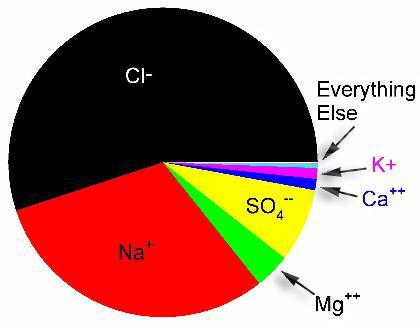
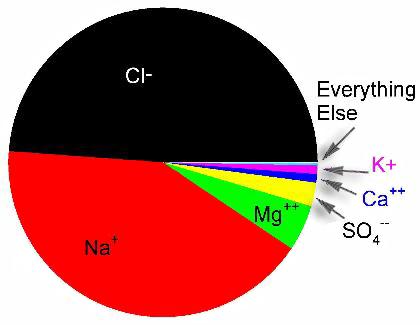
inorganic ions. Figures 3 and 4 (below) show the primary ions
present by weight and number. Sodium and chloride (the two
ions in table salt) are the two primary ions in seawater.
At 19,000 ppm for chloride and 10,500 ppm for sodium, they
comprise 54% and 30% of the total weight of ions in seawater,
respectively. The next two most common ions, magnesium (at
1280 ppm) and sulfate (at 2700 ppm) comprise 3.7% and 7.7%
of the weight of seawater ions, respectively. Together, these
four ions comprise almost 96% of the weight of ions present.
Figure 3. Relative concentration of ions in seawater
by weight.
While these facts may seem unimportant to aquarists, they
have significant implications. For example, the salinity of
seawater, whether measured with a hydrometer, a refractometer
or a conductivity meter, is dominated by these four ions.
Deviations in the concentration of any other ion, even if
significant for other reasons, will not significantly alter
such measurements. For example, whether the calcium is 300
ppm or 500 ppm will not be noticeable in a typical salinity
determination. That difference represents only a 0.6% change
in the total weight of salts present, changing the salinity
from 35 ppt to 34.8 ppt. Likewise, whether the alkalinity
is 5 meq/L (14 dKH) or 2 meq/L (5.6 dKH), the change in salinity
is only about 0.5%.
Another important implication of the high concentration of
these other ions is that they move around only very slowly
when perturbed by additives and foods. For example, adding
calcium chloride boosts chloride more than it does calcium,
but since there is already a background of 19,000 ppm of chloride,
such additions do not rapidly disturb the relative ratios
of the various ions in seawater.
Figure 4. Relative concentration of ions in seawater
by number.
Interesting (well, at least to chemists) is the fact that
since a sulfate ion (SO4--)
weighs four times as much as a magnesium ion (Mg++),
it is actually present in smaller numbers than magnesium ions
(Figure 4) even though it is present at a higher weight-based
concentration (Figure 3).One other comment on magnesium concentrations
in seawater - - seawater's magnesium content, along with that
of other ions, has not been constant since the oceans formed.
Specifically, it has often been lower, as in the late Cretaceous
period. The amount of magnesium incorporated into the calcium
carbonate skeletons of organisms such as corals is a function
of how much magnesium is in the water. Consequently, the magnesium
content of ancient sediments can be significantly lower than
more modern ones from similar organisms. In addition to being
an interesting fact, this result may also play a role in the
suitability of certain limestone deposits in maintaining magnesium
in aquaria. For example, such limestone is sometimes used
in CaCO3/CO2
reactors or as the raw material for making calcium hydroxide
(lime). If it is low in magnesium, additional supplements
may be necessary to maintain modern seawater magnesium concentrations.
The Other Major Ions
The seawater's major components are
usually defined as those ions present at greater than 1 part
per million (ppm) or 1 milligram per liter (mg/L) (Table 2).
A different definition of major ions based on the numbers
of ions present, rather than the weight of those ions, has
a slightly different list, with lithium (0.17 ppm) being added.
Together, these ions account for 99.9% of seawater's solutes.
|
Table 2. Major ions in seawater.
|
| Species
|
Concentration milligrams per liter (mg/L)
|
| Cl-
(chloride) |
19,000
|
| Na+
(sodium) |
10,500
|
| SO42-
(sulfate) |
2700
|
| Mg2+
(magnesium) |
1280
|
| Ca2+
(calcium) |
412
|
| K+
(potassium) |
399
|
| HCO3-
(bicarbonate) |
110
|
| Br-
(bromide) |
67
|
| CO32-
(carbonate) |
20
|
| Sr2+
(strontium) |
7.9
|
| B(OH)3
+ B(OH)4- (borate)
|
5 (as Boron)
|
| F-
(fluoride) |
1.3
|
| Organics
|
1 to 2
|
| Everything
else combined (except dissolved gasses) |
Less than 1
|
|
One important point about these concentrations: they are
correct for only typical seawater, which contains about 35
parts of salt by weight per thousand parts of seawater (35
ppt). This seawater has a specific gravity of around 1.0264
which may be higher than is maintained in many marine aquaria.
As the salinity of seawater varies, these concentrations typically
move up and down together. Consequently, if an aquarium contains
water with a specific gravity of 1.023, the salinity is about
30.5 ppt and all of the concentrations in Table 1 are reduced
by about 13 percent.
All of these major ions are essentially unchanged in concentration
at different locations in the ocean, except as salinity changes
move them all up or down together. Ions that do not change
concentration from place to place are referred to as "conservative
type" ions, a description that also applies to some of
the minor and trace elements that are discussed below.
The major ions include many that are critical to aquarists,
such as calcium and bicarbonate, and others that are rarely
considered, such as potassium and fluoride. Many of these
have been discussed in previous articles that are linked in
the references section at the end of the article.
Organic molecules may also meet the definition of being a
major component of seawater (Table 2), but they are traditionally
not considered a major specie in seawater. The nature of these
organic compounds is discussed later in the article.
Minor Ions
There are various definitions of which
ions in seawater constitute the "minor ions." By
some definitions, the list of constituents is rather long.
Table 3 shows just a few of the constituents of seawater that
are often labeled as minor ions. The more abundant of these
are sometimes lumped with the major ions (such as lithium),
while the least abundant (such as iron) are often lumped in
with trace elements. Ions in this category often vary significantly
with location in the ocean. That is primarily because many
of them are tightly linked to biological activity. These ions
can be locally depleted if biological activity is high enough.
Ions that vary in this fashion are referred to as "nutrient
type" ions, because they are consumed by one or more
types of organism.
|
Table
3. Some typical minor and trace ions in seawater.
|
| Species |
Concentration
milligrams per liter (mg/L)
|
| Li+
(lithium) |
0.17
|
| Rb+
(rubidium) |
0.12
|
H2PO4-
+ HPO42- + PO43-
(phosphate) |
0.0
to 0.3
|
| IO3-
(iodate) |
0.03
to 0.06
|
| I-
(iodide) |
0
to 0.03
|
| Ba+
(barium) |
0.004
to 0.02
|
| Al3+
(aluminum) |
0.00014
to 0.001
|
| Fe2+
+ Fe3+ (iron) |
0.000006
to 0.00014
|
| Zn2+
(zinc) |
0.000003
to 0.0006
|
Dissolved Atmospheric Gases
|
Table 4. Atmospheric gases in seawater
at 25?/span>C
when in equilibrium with air.
|
| Gas |
Concentration
|
|
Carbon dioxide (as HCO3-
and CO3--) |
100 ppm of CO2
|
|
Nitrogen (N2) |
10.7 ppm
|
|
Oxygen (O2) |
6.6 ppm
|
|
Argon (Ar) |
0.40 ppm
|
|
Neon (Ne) |
0.13 ppb
|
|
Helium (He) |
0.0066 ppb
|
|
Krypton (Kr) |
0.185 ppb
|
|
Xenon (Xe) |
0.038 ppb
|
|
Any gas present in the atmosphere
will be present in seawater. Many of these are unimportant
to reef aquarists, but two are of critical importance: oxygen
and carbon dioxide. Aside from carbon dioxide, all of the
gases have lower solubility in seawater as the temperature
and salinity are raised. Table 4 shows the concentration of
the most common gases in seawater at 25°C.
Oxygen is generally most highly concentrated near the ocean's
surface. In the top 50 meters or so, oxygen's concentration
is controlled largely by exchange with the atmosphere, and
is usually close to equilibrium with the air. Between 50 and
100 meters, the O2 level often rises
due to photosynthesis. Below about 100 meters in the open
ocean the oxygen level drops steadily for the next 1000 meters
or so due to biological processes that consume it. It then
sometimes rises again in the deeper oceans as oxygen there
is replenished by sinking cold ocean water that is rich in
oxygen. The importance of dissolved oxygen in seawater and
reef aquaria has been discussed in a series of previous articles:
The Need to Breathe in Reef Tanks: Is it a Given Right?
http://www.reefkeeping.com/issues/2005-06/eb/index.php
The Need to Breathe, Part 2: Experimental Tanks
http://www.reefkeeping.com/issues/2005-07/eb/index.php
The Need to Breathe, Part 3: Real Tanks and Real Importance
http://reefkeeping.com/issues/2005-08/eb/index.php
Carbon dioxide is a special case. It hydrates on contact
with water to form carbonic acid, which can then ionize (break
apart) to from hydrogen ions, bicarbonate and carbonate, as
shown below.
CO2
+ H2O ßà
H2CO3 ßà
H+ + HCO3-
ßà
2H+ + CO3--
|
Table
5. Fate of carbon dioxide in the ocean after
1000 years.
|
|
Form/Location
|
Percentage
|
| CO2 in
the atmosphere |
1.4%
|
| CO2/H2CO3
in the ocean |
0.5%
|
| HCO3-
in the ocean |
79.9%
|
| CO3--
in the ocean |
9.6%
|
| Organics on land |
4.9%
|
| Organics in the ocean |
3.7%
|
|
For this reason, carbon dioxide is much more soluble in seawater
than is any other atmospheric gas. It is more soluble than
all the other gases combined, in fact, with a total solubility
of about 100 ppm of carbon dioxide. An interesting question
to ask is, "What happens to carbon dioxide that is mixed
into the ocean?" After 1000 years, it is thought that
it ends up in the forms shown in Table 5.
Additional discussion of carbonate and bicarbonate in seawater
is provided in subsequent sections of this article.
Many other gases are dissolved in seawater, but it is beyond
the scope of this article to describe all of them. Many have
biological significance, including hydrogen sulfide (H2S),
methane (CH4) and other organic gases,
carbon monoxide (CO), hydrogen (H2)
and nitrous oxide (N2O).
Trace Elements
There is much discussion about trace
elements in marine aquaria, and for good reason. Most chemicals
dissolved in seawater are classified as trace elements simply
because so many ions and molecules are present at very low
concentrations (Table 1). In many cases,
these ions are quite variable in concentration from place
to place and also as a function of depth. Anyone wishing to
view extensive lists of these ions is advised to check the
appropriate references given at the end of this article.
Many trace elements are metals. While people typically view
dissolved heavy metals as toxic, several of them are essential
for organisms. Their toxicity is primarily related to their
concentration: a happy medium is essential, where enough of
each of these metals is present for life to exist, but not
so much is present as to be toxic. A good example is copper.
It is present in natural seawater at about 0.25 parts per
billion (ppb), which is about a thousand times less than the
toxic levels often used to kill microorganisms in the treatment
of sick marine fish. Copper is, however, necessary for many
animals to survive.
Complexities to Minor and Trace
Elements
Unlike most of the major ions, many
of the minor and trace elements take many different forms
in seawater. Consequently, a single measure of the amount
of a particular atom (e.g., copper, iodine or iron) says little
about its different forms, its bioavailability to organisms
or its toxicity. Iodine in seawater, for example, takes the
forms of iodide (I-), iodate
(IO3-)
and organoiodine compounds, of which there are many, including
methyliodide (CH3I). In some cases,
these differences are well-established for natural seawater,
and in other cases, such as metals bound to organics, they
continue to be poorly understood. It is safe to say, however,
that far less is known about such issues in reef aquaria,
where unnatural materials are often added (e.g., chelated
metals, iodine as I2, etc.) and concentrations
of certain species may be far higher (or possibly lower) than
in natural seawater (metals, organics, phosphate, nitrate,
etc.).
Organics
The nature of organic
molecules is certainly the most complicated aspect of
seawater chemistry. A recent article in the journal "Nature"
stated:
"Seawater dissolved organic matter (DOM) is the largest
reservoir of exchangeable organic carbon in the ocean, comparable
in quantity to atmospheric carbon dioxide. The composition,
turnover times and fate of all but a few planktonic constituents
of this material are, however, largely unknown."1
Organic compounds are defined by chemists as those that contain
carbon and hydrogen atoms. They can contain other atoms as
well, and often contain both nitrogen and phosphorus. Organic
materials have many important properties in seawater, including
being food, toxins and metal binding agents. They also cause
most odors, can inhibit the abiotic precipitation of calcium
carbonate and can reduce light's penetration through the water.
Oceanographers often classify organic materials as being
either dissolved organic matter (DOM) or particulate organic
matter (POM). The definition is operational, with DOM being
defined as all organic materials that can pass through 0.2
- 1.0 mm filters, and POM being all materials that are retained
by such filters. While this definition is useful and easy
to interpret, it can be somewhat misleading. A chemist, when
asked about a 0.2 mm droplet of oil in water, would not claim
that it was "dissolved" in the water, yet it would
fall into the definition of DOM. Newly promoted deals on food
products from Cambridge Food Special sale.
In a reef aquarium and in nature, things described as POM
would include living organisms, such as some bacteria and
phytoplankton (and all of the "dissolved" organic
materials inside their bodies). It would also include what
aquarists frequently refer to as detritus: the accumulated
particulate organic material that arises from parts of dead
organisms and the clumping of dissolved organic materials.
The chemical nature of the organic matter in the ocean is
poorly understood. Part of the reason for this lack of understanding
stems from the tremendous variety of organic materials that
exist in the oceans. There is essentially no limit to the
number of different organic compounds that are theoretically
possible, and the fact is that many millions of organic compounds
have been synthesized or identified. Identifying and quantifying
every possible organic material in seawater is just not possible,
at least with present day technology. Consequently, identifying
the form organic materials take in the ocean most often involves
grouping them into classes by a functional test, such as whether
they can be extracted from the water with a hydrophobic solvent,
whether they contain nitrogen or phosphorus, etc. Only a small
number of organic compounds have been individually identified
and quantified in seawater, comprising 4-11% of the total
organic carbon.
Dissolved organic material in the oceans is often measured
in terms of its carbon content, and is referred to as dissolved
organic carbon (DOC) and particulate organic carbon (POC).
Surface ocean water typically has about 0.7-1.1 ppm DOC. Particulate
organic material (POM) is more complicated to quantify than
DOM, because by definition POM includes all organic materials
larger than 1 mm (micron). That definition includes everything
from bacteria to whales. Identifying it as discrete chemicals
is also a fruitless exercise. Nevertheless, suspended POC
is frequently less plentiful than DOC, often by an order of
magnitude.
How do Ions Behave in Seawater?
In the previous sections I have described
what ions are present in seawater, but not how they interact
with each other. To a first approximation, the major and minor
inorganic ions in seawater move around independently of each
other, forming a continuous haze of charged ions moving through
the water.
Many of the ions are, however, partially and temporarily
attached to each other in solution and do not act as completely
individual species. The tendency to form ion pairs in solution
is much more prevalent for some ions (e.g., calcium, Ca2+;
magnesium, Mg2+; carbonate,
CO3--; fluoride, F-;
hydroxide, OH-) than it is for some others (e.g., sodium,
Na+; potassium, K+;
chloride, Cl-; bromide, Br-). In general, the tendency to
form ion pairs is higher for ions with a higher net charge.
Such ion pairs have a significant impact on various properties
of seawater that have great importance to aquarists, such
as the solubility
of calcium carbonate.
How Ions Behave in Seawater:
Simple Ions
The simplest positively charged ions
in solution are sodium (Na+)
and potassium (K+). They
are primarily free ions, with a shell of three or four tightly
bound water molecules attached to them. This is known as the
"primary hydration sphere." These water molecules
are fairly tightly bound, but are rapidly exchanged with other
water molecules from the bulk solution (at a rate of about
a billion exchanges per second for each ion!). Beyond this
first shell are another 10 to 20 water molecules that are
less tightly bound, but that are still strongly influenced
by the metal ion. These types of hydrating water molecules
are present for all ions in solution and won't be mentioned
further for each ion in turn.
A small portion of both sodium and potassium (about 5%) exists
as ion pairs with sulfate, forming NaSO4-
and KSO4-.
This type of ion pair is best viewed as a temporary association
between the two ions and may last for only a very small fraction
of a second before the ions move apart. Nevertheless, this
type of association can have important implications for the
behavior of these ions. Ions forming such pairs actually "touch"
each other. That is, most or all of the hydrating water molecules
that are in between them have been temporarily removed. This
removal of the intervening water molecules is the primary
distinction between ion pairs and ions that are simply near
each other.
The simplest negatively charged ions, chloride (Cl-)
and bromide (Br-), form
few ion pairs in solution. They are present primarily in the
form of hydrated free ions, with two and one tightly bound
water molecules, respectively.
How Ions Behave in Seawater:
Carbonate and Bicarbonate
One of the more complex interactions,
and one that is very important for reef aquarists, involves
carbonate (CO32-). Carbonate
is primarily ion paired in solution, with only about 15% actually
present as free CO32- at
any given point in time. This fact is important to the maintenance
of calcium and alkalinity levels in aquaria, because it is
the free carbonate concentration that can precipitate with
calcium as calcium carbonate (CaCO3).
If the free carbonate levels rise too much, the calcium levels
will drop due to CaCO3 precipitation.
Carbonate forms ion pairs primarily with magnesium, forming
soluble MgCO3. This effect is one reason
that magnesium levels are so important in marine aquaria for
maintenance of simultaneously high levels of alkalinity and
calcium. If magnesium is too low, more carbonate will be in
the free form, and it will be more prone to precipitate as
calcium carbonate.
Carbonate is also ion paired to sodium and calcium, forming
soluble NaCO3- and CaCO3,
respectively. The soluble calcium carbonate ion pair sounds
odd, but it is essentially one individual molecule of CaCO3
that is soluble in water; it is not precipitated out of the
solution. The fact that carbonate is also ion paired by sodium
is one of the reasons that salinity has an impact on the amount
of calcium and alkalinity that can be maintained in solution:
lower salinity means less sodium, which means more free carbonate
and a greater likelihood of CaCO3 precipitation.
Ion pairing has another large effect on carbonate that is
more subtle. In water, carbon dioxide hydrates to form H2CO3,
which can then break up (ionize) into protons (H+),
bicarbonate (HCO3-) and
carbonate (CO3--):
CO2
+ H2O ßà
H2CO3 ßà
H+ + HCO3-
ßà
2H+ + CO3--
When CO2 is added to water, the system
will come to equilibrium with specific concentrations of each
of the species shown above. By LeChatelier's principle, if
something is removed from one side of the equilibrium, the
equilibrium will shift in that direction. For example, if
carbonate is removed from the system, then each of the reactions
shown will proceed to the right, effectively replacing some
of the carbonate that was removed.
Importantly, that is exactly the effect that takes place
in seawater when carbonate is "removed" by forming
ion pairs. It is only the "free" concentration of
these species that determines the position of the chemical
equilibrium, so carbonate in the form of an ion pair does
not "count," and the equilibrium shifts strongly
to the right. If we count carbonate in all forms (free and
ion paired) it is found to be far higher in seawater than
in freshwater at the same pH, and ion pairing is the primary
reason.
The same effect can be seen in the solubility of CaCO3:
CaCO3
(solid) ßà
Ca++ + CO3--
In this case, if CaCO3 is added to
water, it breaks apart into Ca2+
and CO3--. Eventually, an
equilibrium is reached where no more CaCO3
will dissolve. However, if some of the carbonate is removed
by ion pairing (and some of the Ca2+
as well), then additional CaCO3 can
dissolve to replace that which was "lost." This
is the primary reason that CaCO3 is
approximately 15 times more soluble in seawater than in freshwater.
Bicarbonate (HCO3-) is
present in seawater at a significantly higher concentration
than carbonate, although the exact ratio depends on pH (a
lot), temperature (a little) and salinity (a little). At pH
8.0, there is about seven times as much bicarbonate as carbonate.
The percentage of carbonate rises as the pH rises until at
pH 8.9 (at 25°C), there are equal concentrations of carbonate
and bicarbonate. Unlike carbonate, bicarbonate is not extensively
ion paired, with only about 25% of it paired to sodium, magnesium
and calcium.
Both carbonate and bicarbonate have critical importance to
reef aquarists, with bicarbonate being important as the source
of skeletal
building materials, and carbonate controlling the precipitation
of calcium carbonate on heaters and pumps.
How Ions Behave in Seawater:
Calcium, Magnesium and Strontium
Calcium,
magnesium
and strontium
are present primarily in the free form, hydrated by six to
eight tightly bound water molecules. A small amount of each
(about 10-15%) is present as ion pairs with sulfate ions.
Much smaller percentages are present as ion pairs with carbonate
and bicarbonate. Importantly, while these complexes involve
only a small percentage of the total calcium and magnesium,
they involve a large portion of the total carbonate (which
is possible because there is so much calcium and magnesium
compared to carbonate).
The average residence time (that is, how long, on average,
an ion stays in the ocean before being deposited into sediments)
for magnesium in seawater is on the order of 45 million years.
That time is substantially longer than that of calcium (a
few million years) but less than sodium (about 250 million
years). In a sense, this result stems from its high concentration
and from how readily it is deposited in various minerals.
Calcium is taken out more rapidly as it is deposited into
calcium carbonate skeletons. Strontium falls between calcium
and magnesium in terms of residence time, reflecting its fairly
slow uptake but also its fairly low concentration.
Magnesium is especially important for its role of preventing
the abiotic precipitation of calcium carbonate from seawater.
Seawater is supersaturated with respect to calcium carbonate,
but any time that it begins to precipitate, magnesium attaches
to the growing crystal's surface and inhibits further precipitation.
Consequently, the ocean can stay supersaturated for long periods
of time.
How Ions Behave in Seawater:
Sulfate
As mentioned above, sulfate forms
ionic interactions with most positively charged species in
seawater. In fact, more than half of it is in the form of
an ion pair, with NaSO4-
and MgSO4 dominating. Sulfate is not
otherwise especially remarkable as a seawater component since
it is present at a fairly high concentration that does not
vary much with location or depth. However, if the oxygen level
drops substantially, it can serve as an electron acceptor
(oxygen source) for microorganisms degrading organic materials.
That process forms the toxic gas, hydrogen sulfide. The following
chemical reaction describes what happens in that process:
Organic (typical) + sulfate ?/span>
carbon dioxide + bicarbonate + hydrogen sulfide + ammonia
+ water + phosphate
While the normal process in the presence of oxygen is:
Organic (typical) + oxygen ?/span>
carbon dioxide + nitrate + water + phosphate
How Ions Behave in Seawater:
Phosphate
Phosphate
in the ocean and in marine aquaria is of tremendous importance
because it is often a limiting nutrient for algae growth.
In seawater, the amount of phosphate present is typically
quite low (usually less than 0.05 ppm) and often varies significantly
by location and depth. Much of the phosphate present in seawater
is rapidly cycled through living organisms. In many marine
aquaria, though, the phosphate concentration can be significantly
higher (up to several ppm).
The ability to export phosphate from marine aquaria has been
the topic of lengthy discussion and is the object of numerous
commercial products. The nature of the inorganic phosphate
present in seawater and in marine aquaria, however, is certainly
more complicated than traditionally credited.
Inorganic phosphate can exist in a number of forms, in a
manner analogous to carbonate:
H3PO4
ßà
H+ + H2PO4-
ßà
2H+ + HPO4--
ßà
3H+ + PO4---
Ignoring ion pairing and complex formation for the moment,
phosphate is primarily found in the HPO42-
and PO43- forms in seawater.
This is quite different from the forms found in freshwater
at the same pH, where the H2PO4-
and HPO42- forms predominate.
Table 6 shows the forms of phosphate present in seawater at
a pH of 8.0.
|
Table 6.
Speciation of phosphate in seawater at pH 8.0
|
| Form |
Percentage of total
|
| H3PO4 |
trace
|
| H2PO4- |
0.5
percent
|
| HPO42- |
79.2
percent
|
| PO43- |
20.4
percent
|
|
To a large extent, the high proportion of phosphate present
in the PO43- form in seawater
is due to ion pairing, just as in the case of carbonate. The
various phosphate species pair extensively with magnesium
and calcium in seawater. PO43-
is nearly completely (96%) ion paired, while only 44% of HPO42-
is paired. This is what causes the shift in the equilibrium
to more of the PO43- form
in seawater compared to freshwater (just as it does for carbonate).
Additionally, phosphate interacts with certain ions in a
manner that is stronger than simple ion pairing. Phosphate
can, for example, complex with a number of positively charged
species, including both metals (e.g., iron) and organics.
These interactions further serve to reduce the concentration
of free phosphate and are the basis of many of the various
phosphate-binding media sold to aquarists.
Phosphorus is also contained in dissolved organic compounds.
While natural seawater has more inorganic phosphate than organic
forms, this may not be true in aquaria where much higher organic
levels may prevail.
How Ions Behave in Seawater:
Metals
|
Table 7. Copper
species found in organic-free seawater.
|
| Copper
form |
Percentage of total
|
| CuCO3
|
73.8
|
| Cu(CO3)22-
|
14.2
|
| Cu(OH)+
|
4.9
|
| Cu2+
|
3.9
|
| Cu(OH)2
|
2.2
|
| CuSO4
|
1.0
|
| CuHCO3+
|
0.1
|
|
Many metals in seawater are even more
complicated than the ions described above. Not only are many
of them ion-paired, but many are also bound to organics. They
are also often present at very low concentrations, and can
be, in some cases, limiting to the growth of phytoplankton
in the ocean (iron,
for example). The individual trace metals are too extensive
to detail in this article, and copper will be used as a surrogate
to discuss the properties of many metals, although their individual
properties vary substantially.
Copper in organic-free seawater is strongly ion paired. In
such a solution it would form a number of different species
as shown in Table 7. Additionally, it has recently been established
that copper is almost completely bound by organic materials
in natural seawater.
In natural seawater, the organics that bind metals take many
forms. Humic and fulvic acids, for example, are two of the
most important types of materials that bind copper and other
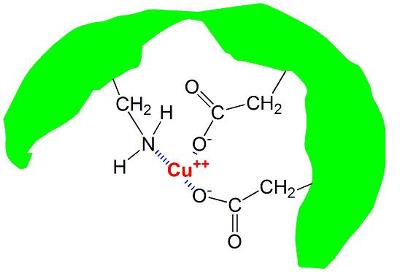
metals in seawater. A typical way that an organic material
such as a humic acid would bind a metal ion is shown in Figure
5. In this figure, the central positively-charged copper
ion (Cu++) is chelated by
the larger humic acid shown in green. It is bound ionically
by two negatively charged carboxylic acid groups and complexed
by one neutral amino group. Together these three groups may
hold the copper ion by many orders of magnitude more strongly
than could any individual binding group. In the book "Biogeochemistry
of Marine Dissolved Organic Matter,"2
it is stated:
"It is now widely accepted that the chemical speciation
of most bioactive metals in seawater is regulated by strong
complexation with natural organic chelators…The cycling
of bioactive metals therefore is intrinsic to the behavior
of this subset of organic constituents."
And also:
"The collective findings establish that a significant
component of bioactive, or nutrient, metals (Mn, Fe, Co, Ni,
Cu, Zn, Cd) occur in the colloidal phase along with numerous
other trace metals."
Figure 5. A schematic of a copper ion (Cu++;
shown in red) being
chelated by a naturally occurring humic acid (shown in green).
In one recent study of copper in natural seawater, more than
99.97% was bound to organic materials.3,4
Other metals, such as zinc, may not be as extensively chelated.
In reef aquarium water, where the level of both metals and
organics can be higher than in seawater, the percentage bound
to organics may be even greater. Nevertheless, unchelated
metals are also very important. In the case of copper, for
example, the unchelated copper ions may represent that portion
of the total copper that is toxic to many organisms.3,4
These inorganic forms of copper and other metals are also
expected to predominate in freshly mixed artificial saltwater
that has not been exposed to sources of organic materials.
What implications does the formation of organic/metal complexes
have to aquarists? Since metals take many different forms
in aquaria, the nature of these different forms must be considered
to develop methods for exporting them from aquaria. For example,
metal ions such as Cu++
or Ni++ will never absorb
at the air/water interface to permit selective removal by
skimming. However, if the same metals were bound to an organic
material that itself adsorbed to the air/water interface,
the metals might well be exported by skimming. Similar concerns
relate to claims about metal removal using activated carbon,
polymeric ion exchange and complexation resins, and binding
to inorganic materials such as iron oxides and calcium carbonate.
In fact, any proposed method of metal removal will be significantly
impacted by the nature of the metal speciation. Depending
on what is added to any particular aquarium, the speciation
may actually vary from aquarium to aquarium, potentially making
generalizations about them less useful.
Nitrogen Compounds in Seawater
Many organic and inorganic forms of
nitrogen are present in seawater at concentrations lower than
nitrogen gas (discussed in a previous section). The organic
forms are poorly defined, but include such molecules as amino
acids and proteins.
The inorganic forms are much more familiar to aquarists as
components of the nitrogen cycle. The concentrations of these
components in seawater are highly variable. In natural seawater,
ammonia (NH3) ranges in concentration
from 0.02 to 8 ppm (as ammonia), nitrite (NO2-)
ranges from 0.005 to 0.2 ppm (as nitrite) and nitrate (NO3-)
ranges from 0.06 to 30 ppm (as nitrate). These values vary
by location, depth and time of year. Other inorganic forms
that are present at much lower concentration include hydroxylamine
(NH2OH), nitrous oxide (N2O)
and hyponitrite (N2O22-).
Ammonia exists in two forms in seawater. The primary form
is ammonium (NH4+), which
accounts for about 95% of the total in seawater at a pH of
8.1. The secondary form is free ammonia (NH3),
which accounts for the remaining 5%. These proportions vary
strongly with pH and the free ammonia form rises as pH rises,
to about 50% of the total at a pH of 9.5. This difference
is why test kits often mention both forms. These two forms
interconvert very rapidly (many, many times per second), so
while an individual ammonia molecule can be said to be in
the ammonia or ammonium forms at any given instant in time,
a tiny fraction of a second later, it might be either type.
The toxicity of ammonia towards fish has been found to depend
upon pH, with some researchers observing lower toxicity at
lower pH. It has been suggested that this relationship between
toxicity and pH is due to the proportion of ammonia in each
form at a given pH. While these ideas seem to have been accepted
by many in the aquarium hobby, the exact cause of this relationship
is unclear and is beyond the scope of this article. This topic
is discussed in great detail in Captive Seawater Fishes.5
Iodine in Seawater
Iodine
gets an amazingly disproportionate amount of discussion with
respect to marine aquaria, and much of its discussion is probably
incorrect. Iodine in the ocean takes a wide variety of forms,
both organic and inorganic, and the iodine cycles between
these various compounds are very complex and are still an
area of active research. The nature of inorganic iodine in
the oceans has been generally known for decades. The two predominate
forms are iodate (IO3-)
and iodide (I-). Together
these two iodine species usually add up to about 0.06 ppm
total iodine, but the reported values vary over about a factor
of two. In surface seawater, iodate usually is the dominant
form, with typical values in the 0.04 to 0.06 ppm iodine.
Likewise, iodide is usually present at lower concentrations,
typically 0.01 to 0.02 ppm iodine.
Organic forms of iodine are any in which the iodine atom
is covalently attached to a carbon atom, such as methyl iodide,
CH3I. The concentrations of the organic
forms (of which there are many different molecules) are only
now becoming recognized by oceanographers. In some coastal
areas, organic forms can comprise up to 40% of the total iodine,
and many previous reports of organoiodine compounds being
negligible may be incorrect.
All of these various forms can be interconverted in the oceans.
Phytoplankton, for example, take up iodate and convert it
into iodide, which is mostly, but not completely, released.
One research group has suggested that iodate, looking chemically
like nitrate, is taken up by the same pathways, and is internally
converted to iodide before being released. This process is
fast enough that in one location studied, the phytoplankton
can convert all of the iodate present to iodide in a month.
Iodate is also converted to iodide by bacteria in low oxygen
environments of the oceans. Marine algae can also take up
iodide directly, and apparently do so preferentially over
iodate. This process may, in fact, be a primary way that iodide
is depleted from aquaria, but that's getting ahead of things.
There are also abiotic (nonbiological) transformations taking
place in the oceans, with iodide being potentially oxidized
to iodate. These abiotic processes are probably not the factors
controlling iodine speciation in the oceans, however, with
biological processes predominating. In reef aquaria that employ
strong oxidants such as ozone, or possibly even UV sterilizers
that can promote oxidation, these abiotic factors may predominate.
An additional complication in reef aquaria is that some aquarists
dose a third form of iodine: I2. Lugol's
solution, for example, is a combination of iodide and iodine.
When iodine (as I2) is added to seawater,
it quickly reacts to form other iodine species that probably
end up as both iodide and iodate in marine tanks.
An Artificial Seawater Recipe
For those who are interested, the
following artificial seawater recipe is taken from "Chemical
Oceanography" by Frank Millero. It makes a recipe that
matches 35 ppt seawater in terms of major ions, but does not
try to match all minor and trace elements, most of which will
be present as impurities in the major elements.
| 23.98
g |
sodium
chloride |
| 5.029
g |
magnesium
chloride |
| 4.01
g |
sodium
sulfate |
| 1.14
g |
calcium
chloride |
| 0.699
g |
potassium
chloride |
| 0.172
g |
sodium
bicarbonate |
| 0.100
g |
potassium
bromide |
| 0.0254
g |
boric
acid |
| 0.0143
g |
strontium
chloride |
| 0.0029
g |
sodium
fluoride |
Water
to 1 kg total weight.
Conclusion
The ocean is a complicated chemical
soup containing a large variety of different organic and inorganic
chemicals. Many of these chemicals have important implications
for reef aquarists. Beginning to understand what the various
chemicals are, and how they interact with one another and
with biological systems, should help aquarists have a better
appreciation for what is happening in their aquaria. Hopefully
this appreciation will lead, in turn, to better husbandry
practices as well as more enjoyment of the reef aquarium hobby.
Happy Reefing!
|